Yes — for most travellers, with one important condition: how you do the loop matters more than the loop itself.
The Ha Giang Loop is a mountain motorbike route, not a theme-park ride. It is genuinely riskier than most things you will do in Vietnam, and injuries — occasionally serious ones — do happen. But the risk is not random. It concentrates in a handful of avoidable situations: inexperienced riders driving themselves, speed on steep descents, riding after dark, bad weather, alcohol, and riding without a valid licence or proper insurance.
Beginners do the loop every week and love it. Almost all of them do it the same way: sitting behind an experienced local driver — an easy rider — or in a private car or jeep. If you are honest about your riding experience and choose the format that matches it, the loop is a manageable adventure, not a gamble.
What actually makes the loop risky
It is tempting to blame “the road”. In reality, the road is only half the story. The pattern behind most incidents on the loop is a combination of rider, road and conditions — and the rider is the part you control.
Inexperience is the biggest single factor. The loop’s passes are steep, winding and narrow, with tight hairpin bends, blind corners and oncoming trucks and buses. A rider who has only ever ridden a scooter on flat, quiet roads — or who has never ridden a manual or semi-automatic bike at all — is learning mountain riding on roads that punish mistakes. Braking too hard on a steep descent, misjudging a blind corner, or panicking when a bus appears around a bend are the classic ways beginners come off.
Speed turns small mistakes into big ones. The loop rewards slow riding twice over: you see more, and you stay upright. Most of the route is not a place to “keep up with the group”. A good group rides at the pace of its slowest rider, and a good guide will say so.
Fatigue builds quietly. A 3-day loop covers roughly 330 km, a 4-day loop roughly 370 km, with days of around 80–150 km on mountain roads. By day three, tired riders make the mistakes fresh riders do not — one real reason to consider the 4-day pace if you are self-driving.
Alcohol is a known contributor. Homestay dinners often come with generous offers of local corn wine, which is much stronger than it tastes. The rule is simple and non-negotiable: if you drink, you do not ride — not that evening, and not the next morning if you are still feeling it.
Being alone raises the stakes. Villages, homestays and other riders are never far away on the main route, but on a quiet stretch a solo rider who comes off the bike may wait a while for help. Solo travel as a pillion passenger is fine; solo self-driving with no experience is a different proposition.
None of this means the loop is “too dangerous to do”. It means the loop is dangerous to do carelessly — and the difference between those two sentences is the whole point of this guide.
Road & weather realities
Here is what you are actually riding on, so you can judge for yourself.
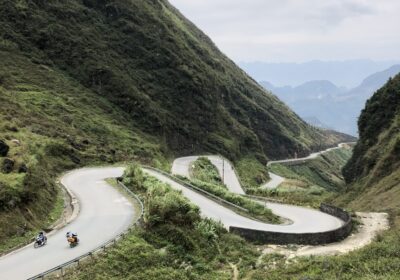
The passes. Ma Pi Leng Pass, between Dong Van and Meo Vac, is the most famous — and the most exposed — section: a road cut into a cliff above the Nho Que River, with drops of several hundred metres and stretches where the barrier is low or absent altogether. Tham Ma Pass, on the way into Dong Van, is a series of tight S-curves that looks spectacular in photos and demands full attention in person. These are paved roads, not dirt tracks, but they are mountain roads: narrow, winding, and shared with buses, trucks, livestock and the occasional wandering buffalo.
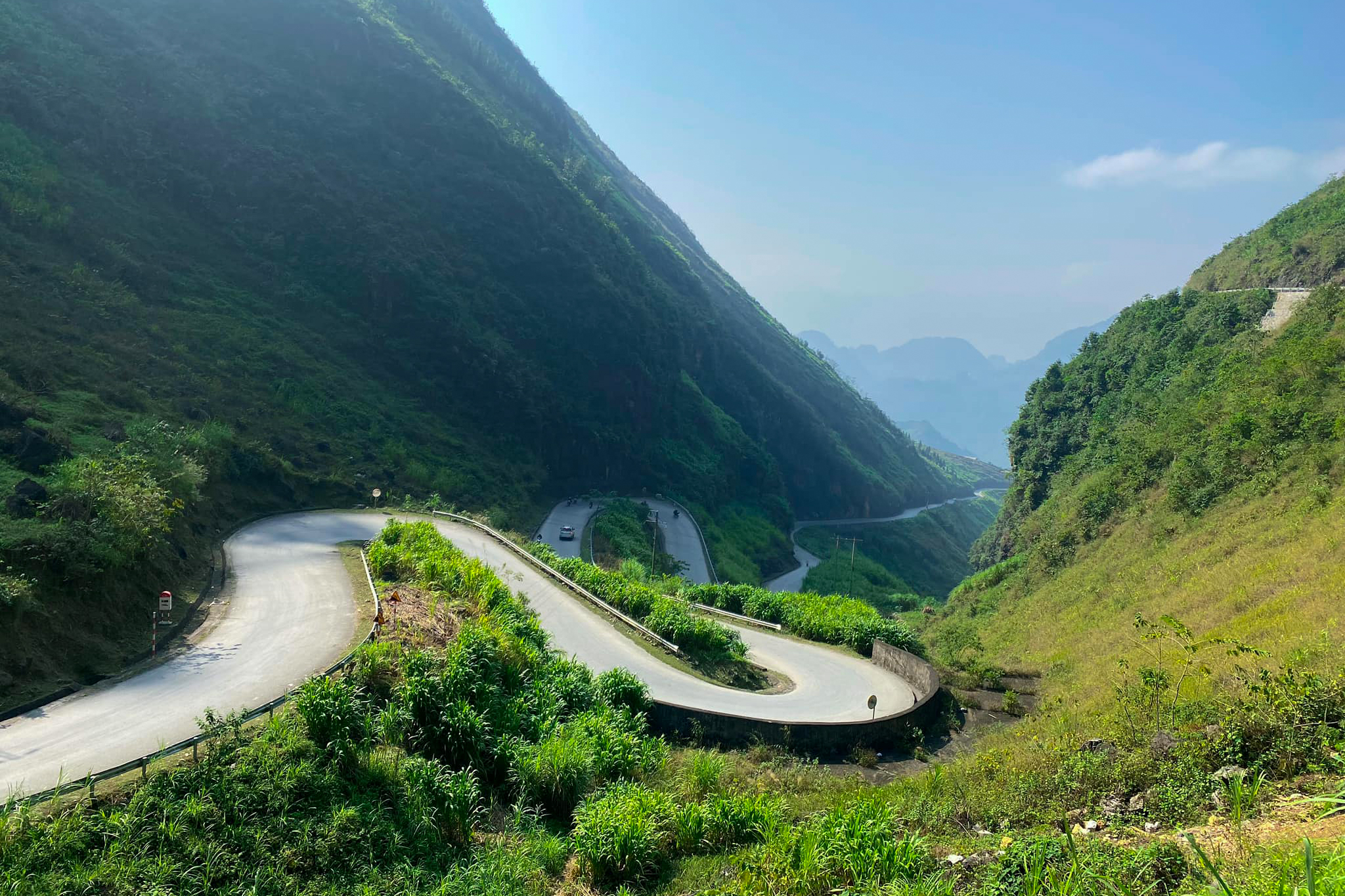
Tham Ma Pass and its tight S-curves on the way into Dong Van. Photo: NKSTTSSHNVN, CC BY-SA 4.0, via Wikimedia Commons.
The surface. Gravel collects on corners, especially after rain. Wet roads hide potholes. Some side stretches, such as parts of the Lung Cu road, can be unpaved and much harder after rain. None of this is unrideable — it is exactly why local drivers, who know where the gravel gathers and which corners tighten, are worth their weight.
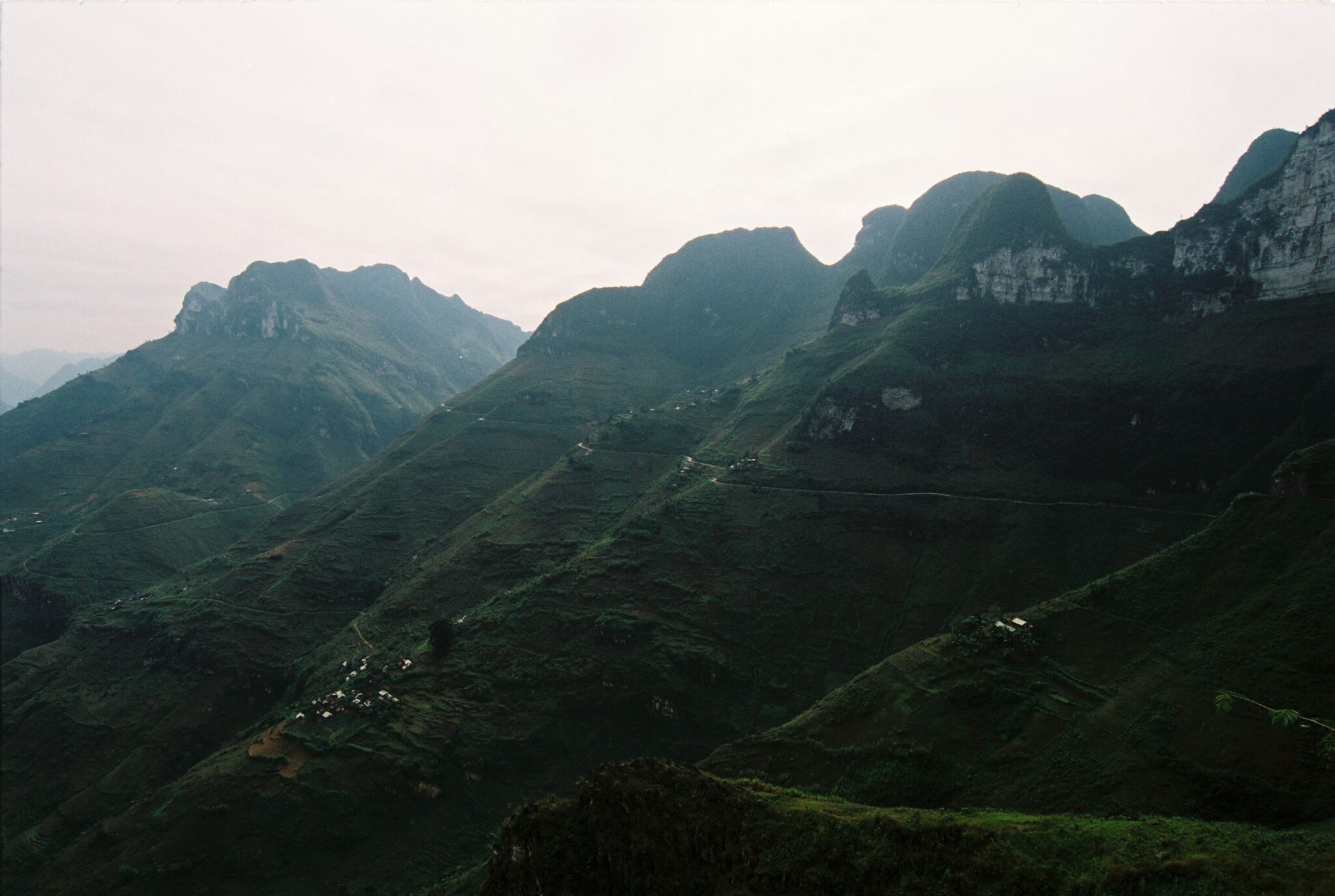
Fog and rain. Fog can close visibility down to a few metres in minutes, year-round but most often from November to February. Rain makes everything slippery and, in the wet season from June to August, brings a real risk of landslides closing sections of road. Winter (December to February) adds cold — below 10°C at altitude — and persistent mist. None of this means you must cancel a trip in those months; it means you need flexibility. A guided group can wait out fog, reroute around a closed section, or call a day early. A solo self-rider with a fixed schedule cannot do any of those things as easily.
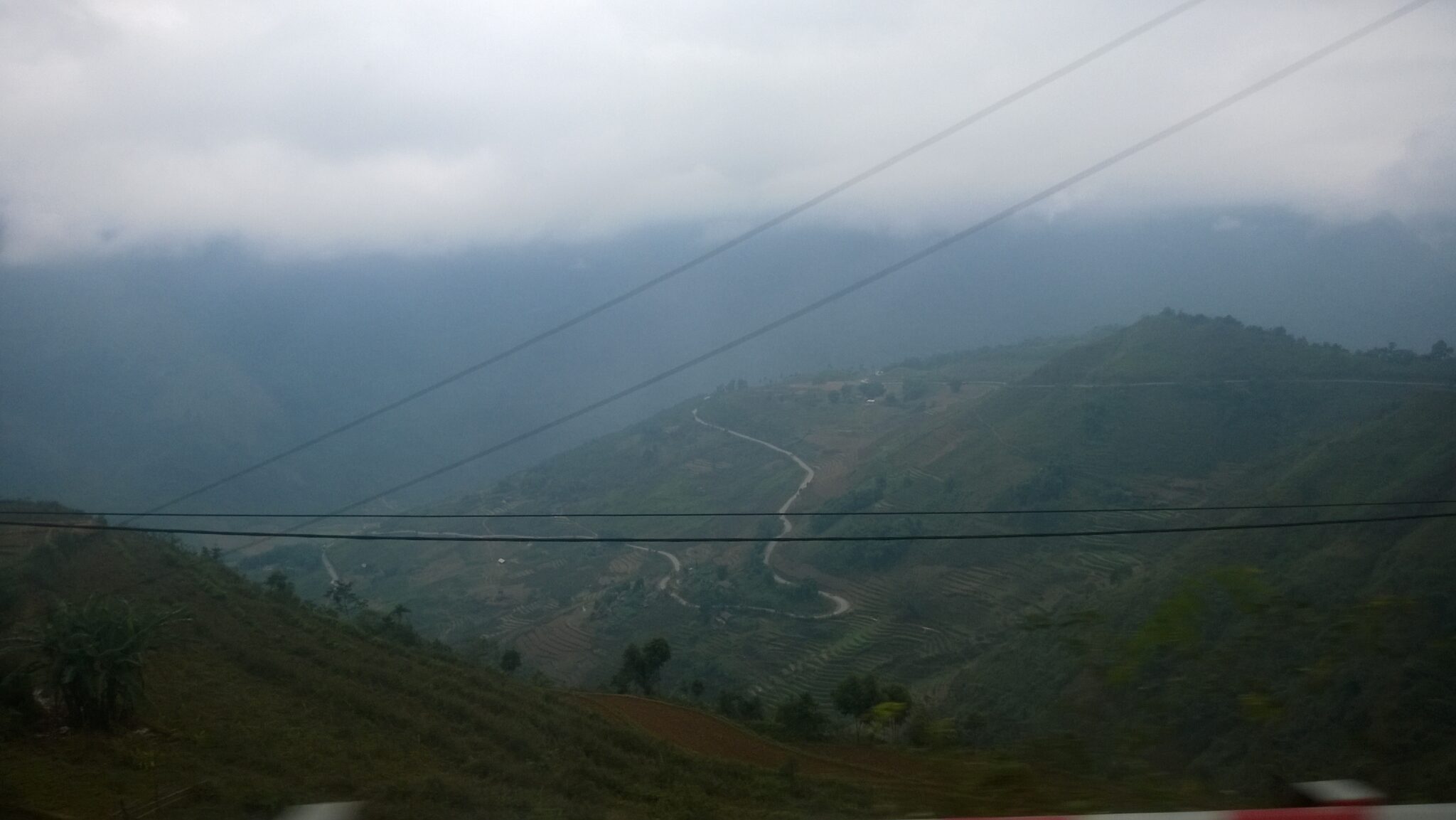
Fog over the Ha Giang mountains can cut visibility to a few metres. Photo: Vuong Tri Binh, CC BY-SA 4.0, via Wikimedia Commons.
Night riding. Do not do it. Mountain roads here have poor lighting, some local vehicles drive without headlights, and animals wander onto the road. Plan every day to arrive at your homestay before sunset — and if you are delayed, stop at the nearest guesthouse rather than pushing on in the dark.
The honest summary: the road is challenging but well-travelled, the weather is the variable you cannot control, and darkness is the risk you should never accept.
The licence & insurance question
This section is dull, and it is the section that matters most after an accident — because it decides whether your insurance pays at all.
Licence. Vietnam only recognises the 1968 Vienna Convention international driving permit (IDP), with the motorcycle category stamped, carried together with your home motorcycle licence. Riders from the US, Canada, Australia, New Zealand and Japan cannot obtain a 1968 IDP at all — their countries issue only the 1949 version, which Vietnam does not recognise. Riding without a recognised licence risks fines, impoundment of the bike, and — most seriously — an insurer refusing your claim because you were not legally licensed. Our full guide explains the rule in detail: Do You Need an IDP for the Ha Giang Loop?
Insurance. Check, in writing, that your travel insurance covers you riding a motorbike in Vietnam — as a driver if you self-drive, and as a passenger if you ride easy rider. Many standard policies exclude motorbikes entirely, or cover them only below a certain engine size, or only when you hold a valid licence for Vietnam. Do not assume; email your insurer and keep the reply.
Two things travellers often misunderstand:
- A rental shop telling you “no problem” is not insurance. It is a sales pitch.
- On Vega group tours, the motorbike damage insurance listed in the inclusions covers the bike’s external parts for self-drivers (engine not included) — it is not personal travel insurance, which is explicitly excluded. Your medical cover is your own policy. Get one that actually covers motorcycling before you arrive.
If you cannot get a policy that covers you, or you cannot ride legally, that is not a reason to ride anyway and hope. It is a reason to ride as a passenger, where the licence question does not apply to you at all.
Why beginners choose easy rider
An easy rider is an experienced local driver: you sit behind them as a pillion passenger while they handle the bike, the road and the navigation. For beginners, this removes the single biggest risk factor — your own inexperience — while keeping everything that makes the loop worth doing: the open air, the viewpoints, the villages, the group.
It also solves several problems at once:
- No licence problem. Your driver holds the licence; you are a passenger.
- Local road knowledge. Your driver knows the blind corners, the gravel patches, the fog-prone stretches and the places where a bus will appear without warning.
- Group pace and support. You travel with a guide and a group, on a set route, with help at hand if anything goes wrong. On Vega tours, self-riding is also offered — but only within guided formats, where you keep the group’s route, support and logistics, and where your licence and IDP are checked before a self-ride booking is confirmed.
- You actually see the scenery. On the best stretches of the loop, a rider must watch the road, not the view. On the back, your only job is the view — and your photos will be better for it.
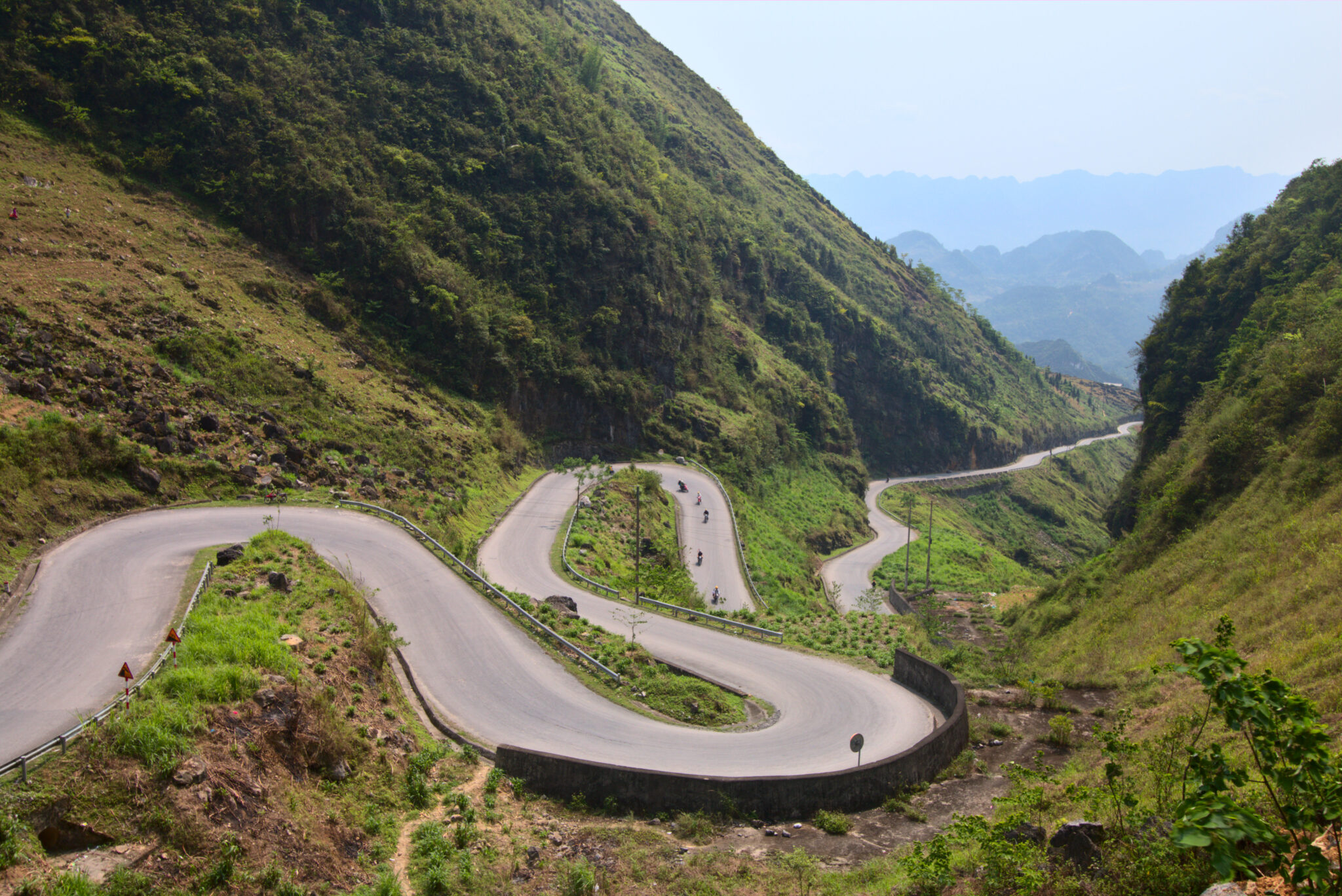
A mountain road in Ha Giang province. Photo: Benjamin Smith, CC BY-SA 4.0, via Wikimedia Commons.
The trade-off is small: less control over stops, and a riding position you do not choose. If you want the motorbike feeling with no riding responsibility at all, the private car or jeep format goes one step further — same route, same stops, four wheels and a roof. Our comparison guide lays out all three: Easy Rider vs Self-Drive vs Private Car.
A word on gear, whichever format you choose: a helmet is not optional, and not all helmets are equal. A thin plastic helmet is barely protective equipment. Before you book any tour, ask what helmet and protective gear it provides — and if you self-drive, bring or buy proper gear: a good helmet, gloves, a jacket, long trousers and closed shoes. Shorts and flip-flops on a mountain pass are how minor falls become memorable scars.
Safety checklist
Use this before you book, and again before you set off each morning.
Before you book
- Be honest about your riding experience. Never ridden a manual or semi-automatic bike? Do not learn on the loop — book easy rider or car/jeep.
- Check your licence situation against the 1968 IDP rule (see above).
- Get travel insurance that explicitly covers motorcycling in Vietnam, as driver and/or passenger, and keep the confirmation.
- Ask your tour what helmet and protective gear it provides, and what happens if weather forces a route change.
- Choose your pace honestly: 4 days is calmer than 3, especially for self-riders. See 3 Days or 4 Days?
- Check the season: our month-by-month guide covers when fog, rain and landslides are most likely.
Every morning on the loop
- Check your brakes before you set off — on mountain descents, they are everything.
- Check the weather and ask your guide about the day’s route conditions.
- Pack rain gear, sun protection, water, a power bank and a basic first-aid kit.
- Download offline maps: phone signal is patchy across the loop.
- Carry cash: card payments are rare in the villages.
- Plan to arrive before dark. If you are running late, stop — do not ride at night.
On the bike
- Ride at your own pace, not the group’s fastest pace. Slow is safe, and safe is fun.
- Use both brakes gently on descents; do not cut blind corners.
- Keep right, use your horn on blind bends, and expect livestock and loose gravel.
- If you drink at lunch or dinner, you are done riding for the day.
- If fog, heavy rain or exhaustion makes you uncomfortable, say so. A good guide would rather adjust the plan than adjust to an accident.
When to skip or postpone
Sometimes the safest decision is not to ride that day — or not to ride at all, yet. Consider postponing or switching format if:
- You have no riding experience and were planning to self-drive. Switch to easy rider or car/jeep instead of cancelling. The loop is still there, and it is still spectacular from the back seat.
- You cannot ride legally or cannot get insurance that covers motorcycling. Same answer: ride as a passenger, where neither problem applies.
- A storm or landslide warning covers your dates. Mountain weather moves fast; a guided operator can advise whether to delay by a day or reroute. A fixed, self-planned itinerary cannot.
- You are unwell, exhausted or hungover. One bad day on the loop is not worth pushing through. Rest, then ride.
- You are travelling with small children or anyone who cannot ride safely as a passenger. The private car or jeep format exists for exactly this group — same loop, no motorbike required.
Postponing is not failing the loop. The loop will still be there next season.
Travelling with Vega
Vega’s Ha Giang group tours are built around the easy-rider format: an English-speaking guide, experienced local drivers, and a set route with group support throughout. The 3-day, 2-night group tour runs from $215 per person and includes the bikes and fuel, all meals, entrance fees, the return transfer between Hanoi and Ha Giang, a dorm bed the night before departure, and luggage storage during the tour. Self-riding is available on private departures, within a guided format, with licence and IDP checks before confirmation.
In safety terms: you are not navigating, setting the pace or solving problems alone — the group structure, local drivers and guide are the safety system. Personal travel insurance is not included, so arrange cover that explicitly includes motorcycling before you travel.
See the tour: Ha Giang Loop 3 Days 2 Nights Group Tour. For the full picture — costs, seasons and getting there — see How Much Does the Ha Giang Loop Cost?, Best Time to Do the Ha Giang Loop and How to Get from Hanoi to Ha Giang.
Frequently asked questions
Is the Ha Giang Loop safe for beginners?
Yes, as a passenger. Beginners should ride easy rider or take a car/jeep, not self-drive. The loop is not a place to learn motorcycling from zero.
Can a beginner do the Ha Giang Loop?
Absolutely — most first-timers do it as easy-rider passengers and have no riding experience at all. The only skill required is holding on and leaning with the bike, which your driver will explain in the first minutes.
Is the Ha Giang Loop dangerous?
It is riskier than most things you will do in Vietnam, and injuries — occasionally fatal ones — have been reported. But the risk is concentrated in avoidable situations: inexperience, speed, darkness, bad weather, alcohol and unlicensed riding. Avoid those, and the risk drops sharply.
Is it safe to self-drive the Ha Giang Loop?
Only if you are an experienced rider with a full motorcycle licence, a recognised 1968 IDP, insurance that covers motorcycling in Vietnam, and experience on mountain roads. If any of those is missing, choose easy rider.
Is the Ha Giang Loop safe in the rainy season?
It is more challenging from June to August: slippery roads, heavy rain, fog and a higher landslide risk. It is still done, but beginners should go guided, allow extra days, and be ready to change plans if conditions turn.
Is the Ha Giang Loop safe for solo travellers?
Yes — solo travellers commonly join group tours as easy-rider passengers. Solo self-driving with little experience is the combination to avoid.
Do I need travel insurance for the Ha Giang Loop?
Yes, and it must explicitly cover motorcycling in Vietnam. Check this in writing before you travel; a policy that excludes motorbikes will not pay out after a bike accident.
Photo credits: featured image — mountain road at Ma Pi Leng Pass by Khánh Hmoong (CC BY 2.0); Tham Ma Pass by NKSTTSSHNVN (CC BY-SA 4.0); misty Ha Giang mountains by Vuong Tri Binh (CC BY-SA 4.0); road in Ha Giang province by Benjamin Smith (CC BY-SA 4.0), all via Wikimedia Commons.