The short answer
If you only remember one thing from this guide, make it this: the three bays share one limestone seascape, but they do not share the same trip. The karsts, the green water and the light at sunset look familiar in all three. What changes is how many boats are around you, what you actually do all day, and which port you leave from.
- Choose Ha Long Bay if this is your first time, you want the famous walk-in caves and viewpoints, and you do not mind sharing them with other visitors.
- Choose Lan Ha Bay if you want a quieter, more active trip — kayaking, swimming, beaches and a day on Cat Ba Island — and the famous cave names matter less to you than the water itself.
- Choose Bai Tu Long Bay if quiet matters most, you are happy with fewer boats and fewer choices, and you would rather sail further east than tick off the classic sights.
And one rule that matters more than the bay name: choose the actual route and boat, not just the bay on the brochure. Two cruises sold as “Ha Long Bay” can visit different caves, spend very different amounts of time on the water, and anchor in very different company. Read the day-by-day itinerary before you compare prices.
The three bays at a glance
| Ha Long Bay | Lan Ha Bay | Bai Tu Long Bay | |
|---|---|---|---|
| Where it sits | East of Hanoi, around Ha Long City (Quang Ninh) | East of Cat Ba Island (Hai Phong), south of Ha Long Bay | Northeast of Ha Long Bay, towards Van Don (Quang Ninh) |
| Character | The classic, most famous bay | The active, quieter neighbour | The most secluded, slowest bay |
| Crowds | Busiest, especially at the headline caves | Noticeably quieter on the water | Quietest, fewest boats |
| Signature experience | Big walk-in caves, viewpoints, classic cruise | Kayaking, swimming, beaches, Cat Ba Island | Long, empty sailing, island beaches, fishing villages |
| Best for | First-time visitors, classic sights, widest cruise choice | Active travellers, couples, families who want to swim and paddle | Travellers who want peace and do not need the famous names |
| Watch out for | Sharing viewpoints with many boats at peak times | Some routes cross into Ha Long Bay waters — check the real route | Fewer boats and departures to choose from; check what is actually running |
All three sit in the same flooded limestone landscape in the Gulf of Tonkin, about 150–170 km east of Hanoi. Ha Long Bay is the best known of the three, with around 1,969 islands and islets often cited for the bay itself. Lan Ha Bay is much smaller — roughly 7,000 hectares with around 400 islands and islets, and more than 130 small beaches — which is part of why it feels more intimate. Bai Tu Long Bay stretches further east, with hundreds of islands of its own, and a national park of the same name covering about 15,783 hectares of land and sea.
A note on names, because brochures blur them: the UNESCO World Heritage property is officially called Ha Long Bay–Cat Ba Archipelago, after Cat Ba Archipelago was added in 2023. Bai Tu Long Bay is a neighbouring cruising area, not a third named section of that property. That distinction does not make it less beautiful — it just means you should not judge it by a UNESCO label it does not carry.
Ha Long Bay: the classic, and still the classic for a reason
Ha Long Bay is famous because it delivers exactly what the postcards promise: towering limestone islands rising straight out of green water, huge caves you walk through on foot, and viewpoints that need no filter. Sung Sot (Surprise) Cave is the big one — two large chambers, well lit, and busy for a reason — and Ti Top Island pairs a small beach with a climb to a panoramic viewpoint. If your Vietnam trip is short and you want the sights you have already seen in photographs, this is the most reliable way to get them.
The trade-off is company. Ha Long Bay has the widest choice of cruises, from budget day boats to luxury overnight ships, and the most boats on the water. At the headline stops, especially around midday, you will share caves, beaches and viewpoints with other groups. That is not a reason to avoid Ha Long Bay — it is a reason to choose your cruise carefully. An overnight cruise wakes up on the water before the day boats arrive, and a boat that follows a longer, outer route spends less of the day in the busiest channels. Ask how long the boat actually spends cruising versus sitting at a single stop, and what time it reaches the main cave.
Ha Long Bay also suits travellers who want the most choice. If you need a specific cabin type, a private charter, a luxury ship or the lowest price, you will find the most options here, because this is where the most operators compete. Just remember that the cheapest ticket usually buys the shortest time on the water and the most crowded route — the comparison that matters is the itinerary, not the headline price.
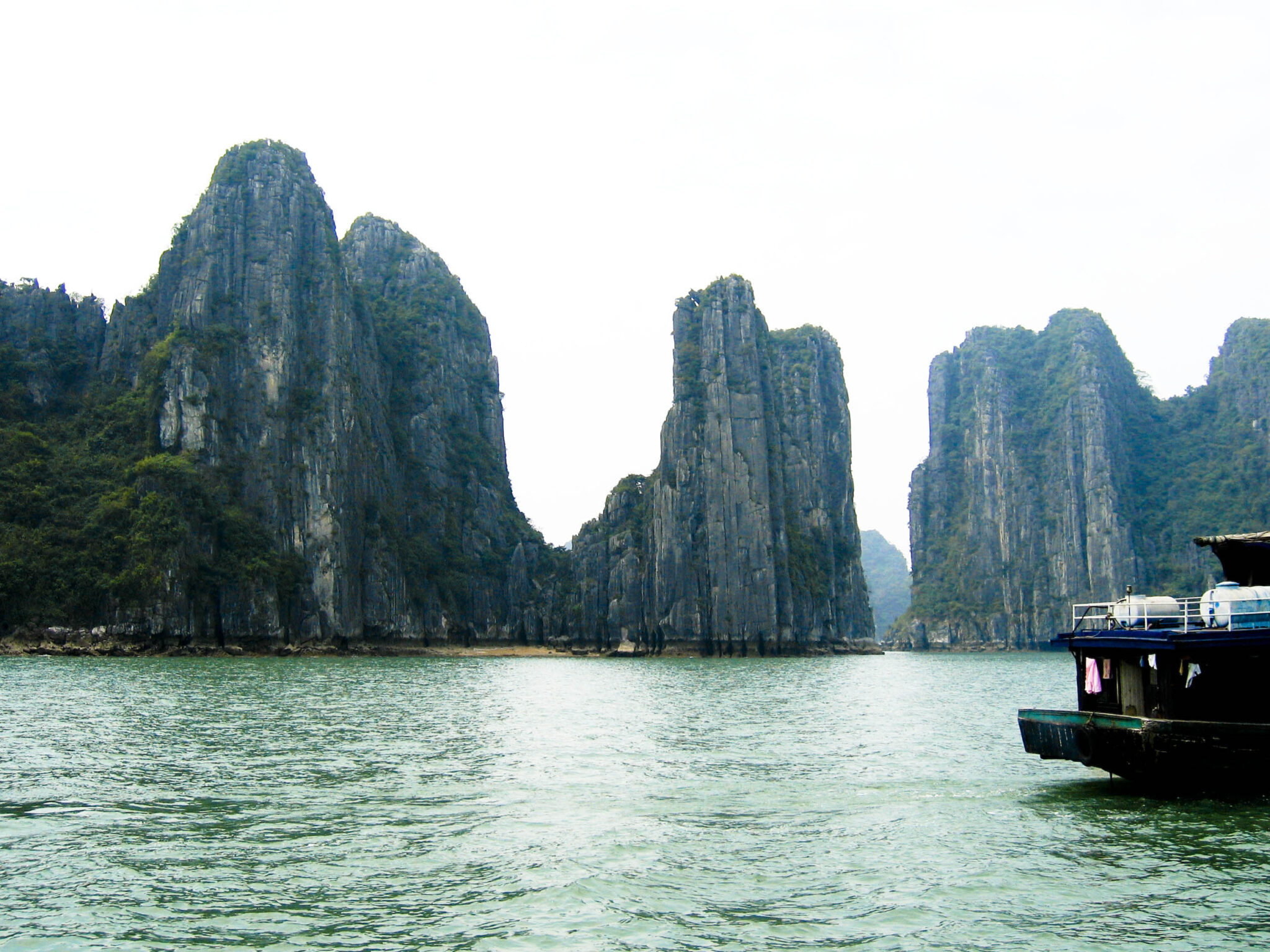
Limestone karsts rising from Ha Long Bay. Photo: Abai2k, Wikimedia Commons (CC BY-SA 3.0).
Lan Ha Bay: the same scenery, a different day
Lan Ha Bay sits just south of Ha Long Bay, east of Cat Ba Island, and it is the bay most first-time visitors have never heard of — which is precisely its appeal. The limestone scenery is the same family, but the day feels different: fewer large ships, more time in sheltered coves, and an itinerary built around being in the water rather than walking through it.
This is the bay for kayaking and swimming. The best-known paddling area is the Dark and Bright Cave (Hang Sang and Hang Toi), where a low, water-level passage opens into a hidden lagoon ringed by cliffs. Small boats and kayaks can slip through where a cruise ship cannot go. Around the bay, Ba Trai Dao (Three Peaches) and the Tra Bau area offer the swimming stops that Ha Long Bay’s bigger, busier anchorages often cannot match, and Lan Ha’s many small beaches — more than 130 of them — mean a swim stop does not have to mean a crowded beach.
Lan Ha Bay also gives you Cat Ba Island, and that changes the trip. A 2- or 3-day cruise here can pair the bay with a cycle ride to Viet Hai village, tucked into a valley inside Cat Ba National Park, or a trek in the park itself. If your idea of a good cruise day includes getting off the boat and doing something, rather than watching the scenery from the sundeck all day, Lan Ha Bay is usually the better fit.
Two practical notes. First, getting here takes a different route: most Lan Ha cruises run from Hanoi via Hai Phong to Cat Ba Island (by road and ferry, or via the sea-crossing bridge to Got Pier), or depart from Tuan Chau and cross into Lan Ha waters — so check the boarding point on your ticket, because it changes your morning. Second, activities on the water are regulated and can change: kayaking in Lan Ha Bay was suspended by local authorities in late 2024 pending new rules, so before you book a trip for the kayaking, confirm with your operator whether kayaking is currently included on that exact departure. Do not assume a brochure photo from an earlier season is a promise for your date.
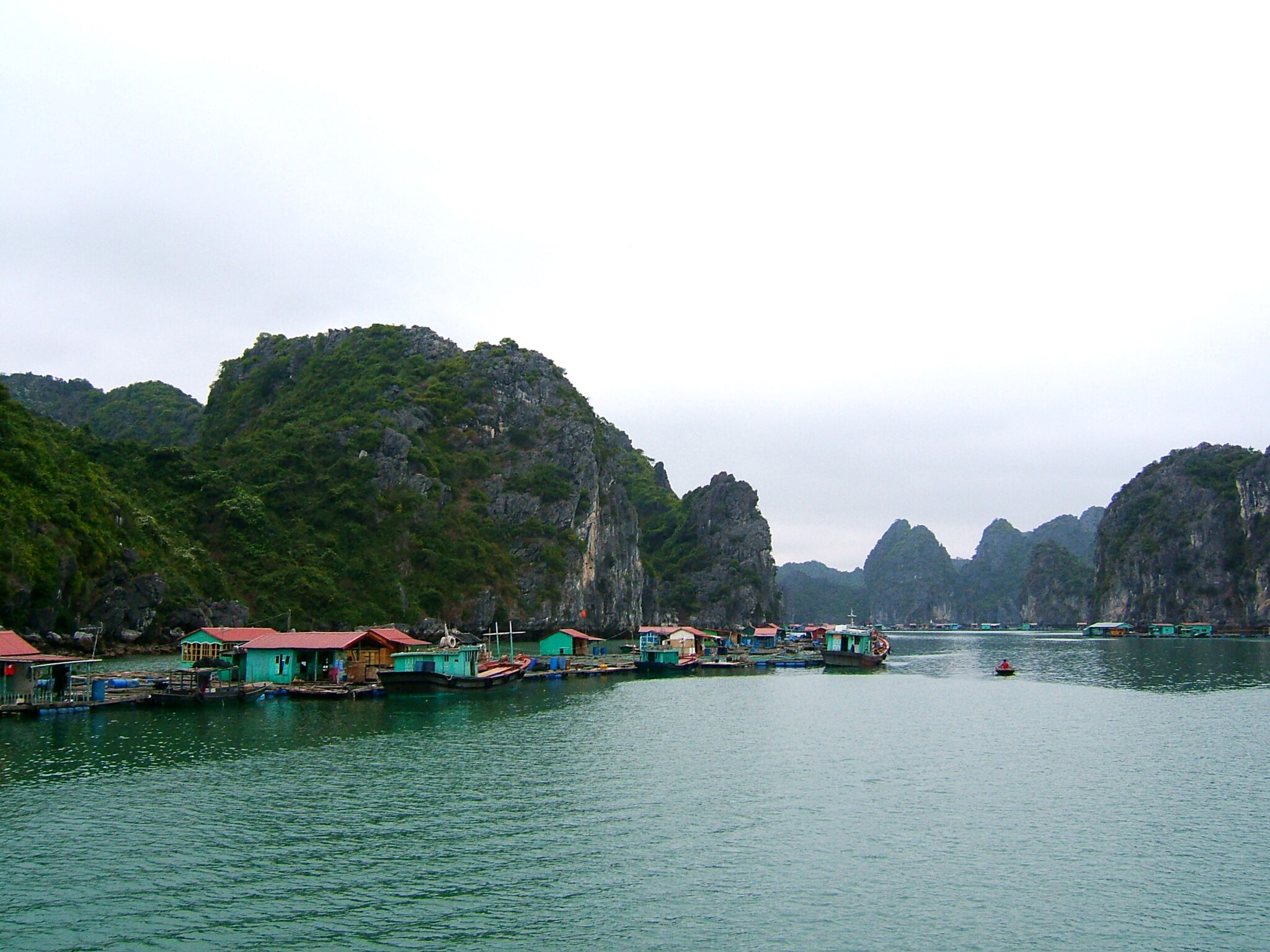
Lan Ha Bay off Cat Ba Island. Photo: Viethavvh, Wikimedia Commons (public domain).
Bai Tu Long Bay: the quiet east
Bai Tu Long Bay is the bay you choose when you have already seen the photographs and decided you would trade the famous names for space. It lies northeast of Ha Long Bay, stretching towards Van Don, and it feels more spread out: the islands are less densely packed, the water is often described as clearer, and the boats are far fewer. If Ha Long Bay is a gallery and Lan Ha Bay is a playground, Bai Tu Long Bay is a long, quiet coastline you sail for its own sake.
What you give up is choice and convenience. There are far fewer cruises here than in Ha Long Bay, fewer departures each week, and fewer of the big, walk-in caves that anchor a Ha Long itinerary. The pleasures are different: long stretches of open water, island beaches such as those around Quan Lan and Minh Chau, fishing villages, and the sense that the boat you are on is not one of a convoy. Thien Canh Son Cave is the walk-in cave most Bai Tu Long itineraries include, and it is a smaller, calmer experience than Sung Sot — which, for many travellers, is the point.
Bai Tu Long Bay also suits a longer, slower trip better than a rushed one. A day trip from Hanoi spends most of its hours on the road and very little on the eastern water, so this bay rewards an overnight cruise, or a stay on Van Don or Quan Lan combined with a local boat. If your priority is “see the famous bay in one day”, this is the wrong choice. If your priority is “get away from the crowds and still see the karsts”, it may be the best one.
Which bay for which traveller?
First time in Vietnam, short on time. Choose Ha Long Bay, overnight if you can. You get the classic caves and viewpoints, the widest choice of boats, and the easiest logistics from Hanoi. Pick a boat whose itinerary spends the morning at the main cave before the day boats arrive, or one that sails an outer route.
Active travellers, couples and families who want to swim and paddle. Choose Lan Ha Bay. The kayaking, the swimming stops, the beaches and the Cat Ba day (Viet Hai cycling or a national park trek) make a fuller, more physical trip than a sightseeing-only cruise. Confirm kayaking availability for your date before you book.
Travellers who have seen Ha Long Bay before, or who hate crowds. Choose Bai Tu Long Bay, overnight. You trade the famous cave names for quiet water, island beaches and a route that does not feel like a procession. Book early, because departures are fewer.
Travellers who cannot decide. Choose the route, not the bay. A Lan Ha cruise that crosses through Ha Long waters (or the reverse) can give you a little of both — a famous viewpoint plus a quiet anchorage — and for many first-time visitors that hybrid is the honest best answer. Vega’s UniCharm cruises work this way: they sail a hidden route out of the busiest Ha Long channels and overnight in Lan Ha Bay, which is why they appear in this guide as a Lan Ha option even though the journey starts in Ha Long waters. Check the day-by-day route on the tour page before you decide, whichever operator you book with.
Day trip or overnight? The decision that changes every bay
Whatever bay you pick, the second decision matters as much as the first. A day trip from Hanoi means roughly 2.5–3.5 hours each way by road (longer with a ferry leg to Cat Ba), which leaves only a few hours on the water. That can still be a good day — a swim, a kayak, a cave, lunch on board — but it is a taster, not the full experience.
An overnight cruise changes the rhythm entirely. You wake up on the water, you get a second morning of cruising before the day boats arrive, and on a 3-day cruise the second day can reach places a 2-day trip never gets to — Cat Ba’s interior, for example, or a further anchorage. If you can spare the extra night, it is almost always worth it, in any of the three bays. The rule is simple: if the bay matters to you, give it a night.
The route matters more than the bay name
Before you book, ask these five questions — of any operator, including us:
- Which port do we board at, and what time? Tuan Chau, Got Pier and Ao Tien/Van Don all lead to different water, and a late boarding eats into your cruising day.
- Which caves, beaches and villages are actually on the itinerary, in order? “Ha Long Bay” on a brochure can mean the central route, an outer route, or a Lan Ha crossing.
- How much time is on the water versus in transit? A day trip that spends 5–6 hours on buses and 3 hours on a boat is a different product from one that sails for 6 hours.
- Is kayaking (or the activity you care about) included on this departure? Rules and seasons change; a photo is not a guarantee.
- What happens if weather cancels the sailing? Storm season runs roughly July to September, and winter mornings can be misty. Ask about the operator’s rebooking or refund policy before you pay, not after a cancellation notice.
If an operator cannot answer those five questions clearly, that tells you more than any brochure photograph.
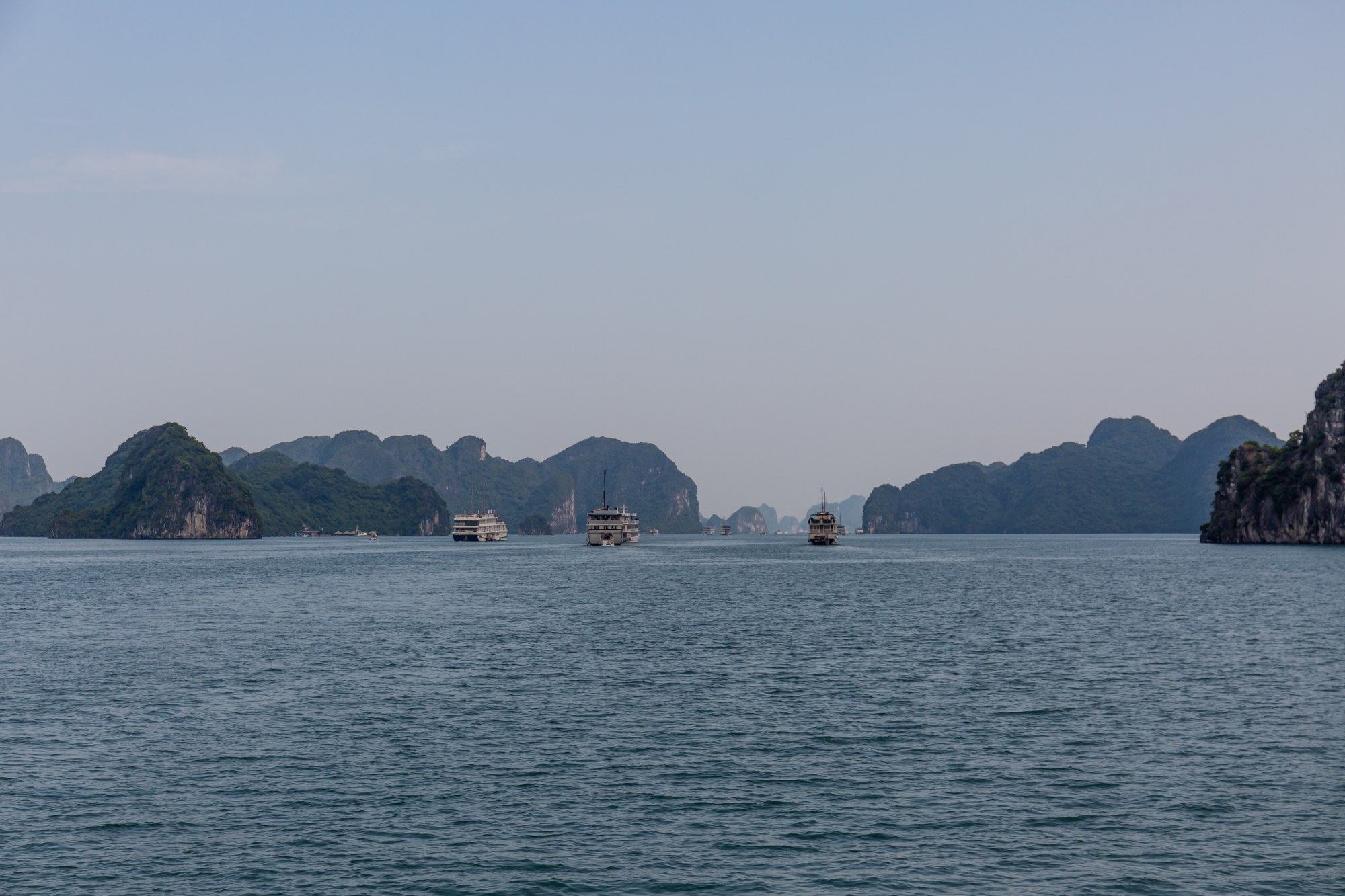
A view from a boat in Ha Long Bay. Photo: Balon Greyjoy, Wikimedia Commons (CC0).
Travelling with Vega: what we actually sail
Vega Travel has run tours in Vietnam since 2001 from its Hanoi office at 75A Nguyen Huu Huan, in the Old Quarter, and holds international tour operator licence 0324/2004/TCDL-GP-LHQT. On the bays, our cruise product is UniCharm, a 4-star ship that sails a quieter route: out of the busiest Ha Long channels, through Cua Van — the meeting point of Ha Long Bay and Lan Ha Bay — and on to overnight in Lan Ha Bay, with kayaking and swimming stops, a cycle ride to Viet Hai village, and, on the 3-day sailing, a trek in Cat Ba National Park.
- UniCharm 2 Days 1 Night — from $155/person
- UniCharm 3 Days 2 Nights — from $300/person
- Traditional Junk 2 Days 1 Night — from $120/person (page notes temporarily closed for maintenance — confirm availability before booking)
The Traditional Junk sailing is the more classic, mid-range Ha Long Bay overnight option — a good fit if you want the famous bay itself at a softer price, rather than the hidden Lan Ha route. Prices and inclusions change with season and cabin, so check the tour page for the date you want before you decide; the links above go to the live tour pages.
Vega does not currently sell a Bai Tu Long Bay cruise, and this guide says so plainly: if Bai Tu Long is your choice, book it with an operator that sails that bay properly, and use the five questions above to judge them. A guide that only recommends what its author sells is not a guide you should trust.
Frequently asked questions
Is Lan Ha Bay better than Ha Long Bay?
Better for what? For kayaking, swimming, beaches and a quieter day on the water, usually yes. For the famous big caves, the classic viewpoints and the widest choice of ships, Ha Long Bay still wins. Neither bay is better in the abstract — the better bay is the one that matches the day you want.
Can I visit two bays on one cruise?
Yes — many Lan Ha cruises pass through Ha Long waters, and some Ha Long routes cross into Lan Ha Bay. That is why the route matters more than the bay name on the brochure. Read the day-by-day itinerary, and ask which bay you actually overnight in.
Which bay is least crowded?
Bai Tu Long Bay, by a clear margin, followed by Lan Ha Bay. Ha Long Bay’s central route is the busiest water in the region. Overnight cruises and outer routes reduce the crowd effect in any bay.
Do I need to worry about the weather?
The most reliable cruising weather is generally March to May and September to November. July to September brings the highest storm risk, and winter (December to February) can be misty and cool, though the mist has its own beauty. Boats do not sail in storm warnings, so ask about the rebooking policy when you book.
Is a day trip from Hanoi worth it?
It can be, if your time is genuinely limited — you still get several hours on the water, a cave or lagoon, and a swim stop. But the road takes a large share of the day, so if you can add one night on the boat, do it. The overnight experience is a different trip, not just a longer version of the same one.
Which bay should families with children choose?
Lan Ha Bay is usually the easiest family choice: shorter sailing legs, swimming beaches, kayaking and a Cat Ba day that gives children something to do beyond sightseeing. Ha Long Bay works well too if you choose a ship with family cabins and a calm itinerary — ask about cabin layout and the day’s pace before booking.
Photo credits: featured image and in-article photos via Wikimedia Commons — see captions. Vega tour prices and inclusions checked against Vega’s live tour pages on 1 November 2026; prices can change, so confirm at booking. Bay facts checked against multiple published guides and the UNESCO listing for Ha Long Bay–Cat Ba Archipelago in November 2026.